
Agentforce for Public Sector Wage Enforcement
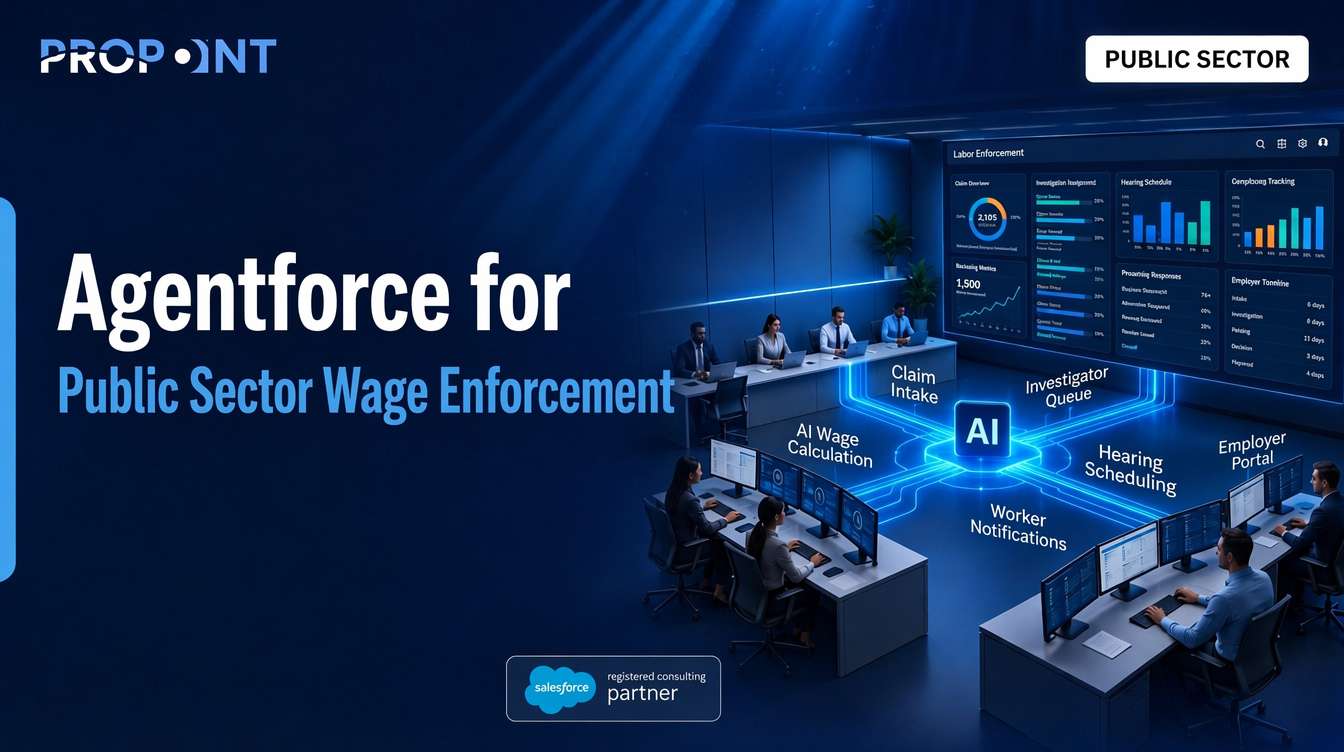 Wage claims run on a clock that doesn’t stop for staffing shortages. When intake, calculation, and routing are still manual, the people who pay for it are the workers waiting on money they’re owed.
The Challenge
Labor enforcement divisions are responsible for processing wage claims and complaints under some of the strictest timelines in government. A single claim touches multiple people before it’s resolved: the worker who files it, the intake team that logs it, an investigator who calculates what’s owed, and a hearing officer who schedules and rules on it.
In most agencies, that entire chain still runs on paper intake, spreadsheets, and manual handoffs between departments. Two problems compound as claim volume grows:
- Intake and calculation are disconnected, so errors and delays creep in at every handoff, and investigators lose hours to data entry instead of enforcement.
- Workers, employers, and hearing officers have no visibility into where a claim stands, so staff spend as much time answering status calls as they do resolving cases.
Without addressing both problems together, claim backlogs grow, statutory deadlines get harder to meet, and worker trust in the system erodes.
How Agentforce Helps
Agentforce Public Sector runs inside the Salesforce environment most labor agencies already have, no rip-and-replace, no multi-year rebuild. For labor enforcement specifically, it targets four points of friction in the claims process:
1. Online Intake with Automated Validation
Claims submitted online are checked for completeness automatically, so incomplete filings are flagged and returned before they ever reach an investigator’s queue.
2. AI-Assisted Wage Calculation Support
Routine wage calculations – based on violation type, minimum wage inputs, hours, and other claim variables – are handled with AI assistance, freeing investigators to spend their time on claims that require real judgement rather than arithmetic.
3. Real-Time Status Notifications
Workers, employers, and hearing officers all receive automatic status updates at each stage, replacing the phone call as the default way to check on a claim.
4. Intelligent Case Routing
Claims are routed to the right investigator or hearing officer automatically, removing a manual sorting step that otherwise adds days to every case.
Why It Matters
- Investigators get their time back for actual enforcement work, no data entry.
- Workers stop having to call in for updates, because they already have them.
- Agencies become more consistent about meeting statutory deadlines, even as claim volume grows.
- None of it requires replacing infrastructure the agency owns and knows how to run.
See It In Action
This isn’t theoretical. A California labor agency used this exact approach to move wage claims from 0% online to 66% in just three months, while scaling to handle a projected 40,000 claims a year. Read the full case study: “From Zero to 66%: How a California Labor Agency Moved Wage Claims Online in 3 Months.”
Is Your Agency Feeling This?
If wage claims or labor complaints are still moving through manual intake and disconnected systems, the bottleneck isn’t your staff – it’s the process around them. Agentforce Public Sector is already proven in exactly this kind of high-volume, deadline-driven environment.
Contact us today to see how Agentforce Public Sector could fit your agency’s labor enforcement workflow.